Release Notes – Consolidated Security Reporting
Overview
This release introduces Unified Security Reporting, a major enhancement that consolidates multiple industry-standard security classifications into a single, consistent reporting framework within AquilaX. The update improves visibility, reduces fragmentation across tools, and accelerates vulnerability triage and remediation workflows.
Key Features
✔ Unified Report View
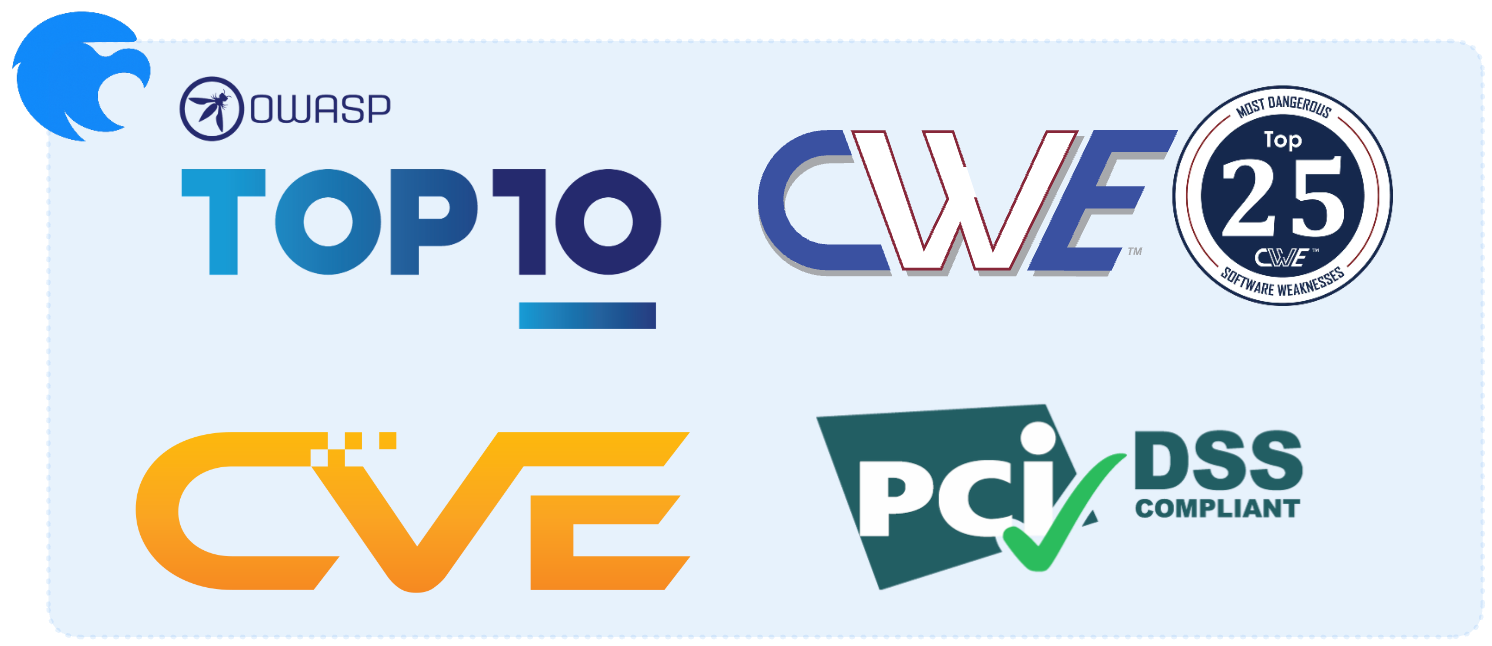
All supported security frameworks are now available in one centralized dashboard, including:
OWASP Top 10
CWE Top 25
CVE Exposure
PCI DSS Alignment
Each finding shows its mapped classifications, technical evidence, severity scoring, and remediation guidance.
✔ Automated Classification Mapping
AquilaX automatically correlates findings and applies cross-framework mappings:
CVE → CWE → OWASP
Code-level finding → CWE structural weakness
Control-level finding → PCI DSS requirement
This enables engineers to quickly understand root causes and compliance impact.
✔ Normalized Severity Model
Findings coming from multiple scanners now follow a unified severity scale.
This reduces inconsistent scoring and helps teams prioritize more effectively.
✔ Deduplication Engine
The system identifies and merges duplicate issues across static analysis, dependency scanning, runtime monitoring, and configuration checks.
This ensures one issue = one source of truth.
✔ Export Support
Unified reports can now be exported in:
JSON (API + CLI)
PDF
CSV
Extended SBOM formats
Exports preserve complete classification mappings and traceability back to the originating scanner.
Why This Matters
Modern security pipelines generate findings from numerous independent tools. Without consolidation, teams face duplicated data, varied severities, and manual interpretation overhead.
This release eliminates these challenges by delivering a single, coherent security posture overview for the entire application lifecycle.
Additional Improvements
Performance optimizations to reduce report loading times
Improved mapping engine for mixed-language repositories
Updated compliance schemas for PCI DSS v4.0
Extended dependency graph resolution for polyglot builds
Availability
This feature is now available for:
Ultimate Tier customers
All deployment modes (cloud, hybrid, and on-prem)